
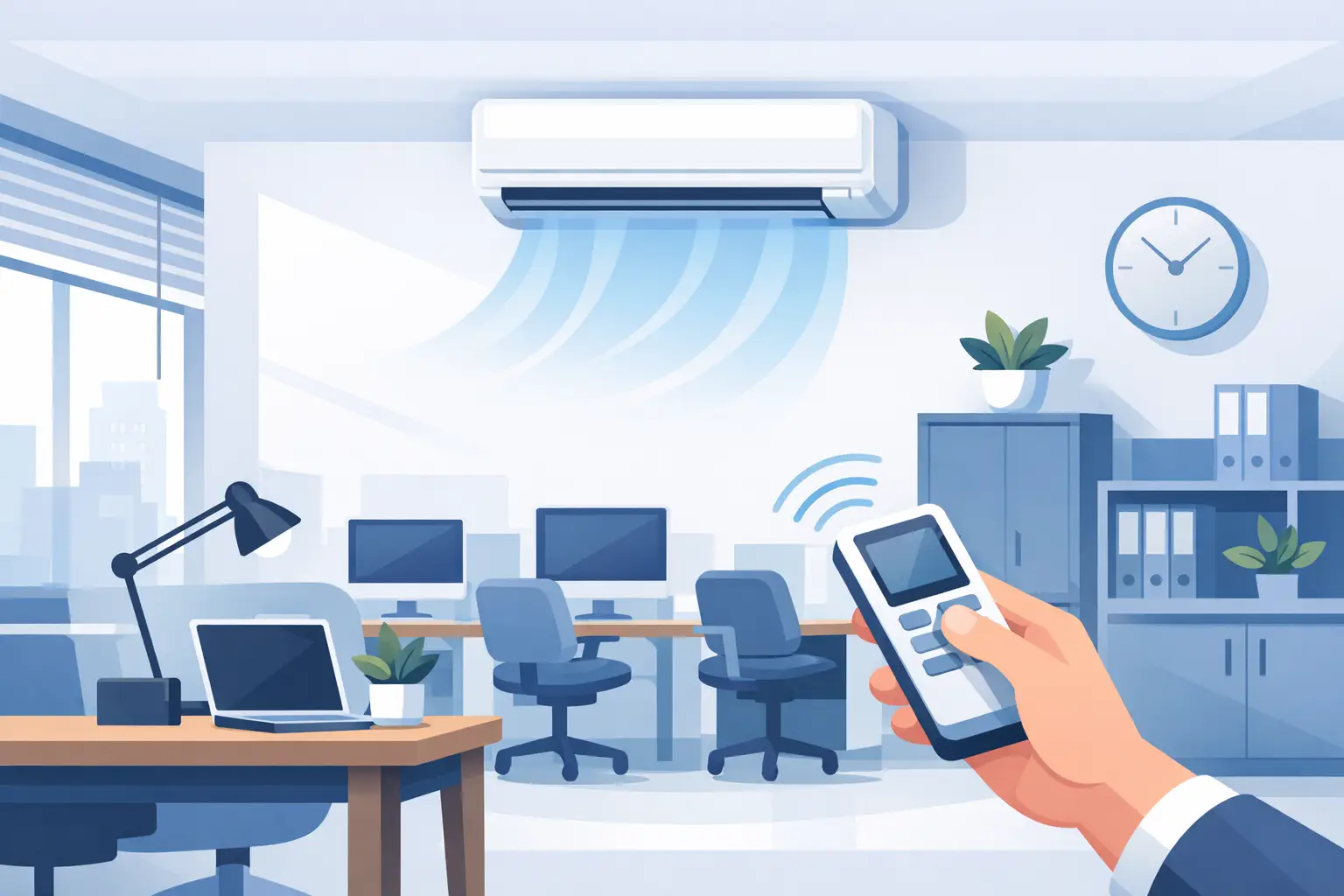
A cramped office that is too hot by 10 am is not a minor comfort issue. It affects concentration, customer service and staff morale, particularly through an Adelaide summer. The best aircon for small office use is usually one that is correctly sized, quiet enough for focused work and installed properly for the room, rather than simply the biggest unit available.
For many small offices, a quality reverse-cycle split system is the sensible choice. It provides cooling in summer, heating in winter and dependable day-to-day control without the cost and disruption of a full ducted system. But the right answer depends on the office layout, heat load and how the space is actually used.
Best aircon for small office spaces: start with the room
Before choosing a brand, work out what the system needs to handle. Floor area is a useful starting point, but it is not the full picture. A 25-square-metre office with one person, insulated walls and limited afternoon sun has very different cooling demands to a similarly sized office with four computers, west-facing glass and staff coming and going all day.
A technician should assess the room dimensions, ceiling height, window size and orientation, insulation, occupancy and equipment that produces heat. Computers, printers, servers, display lighting and even a busy reception counter all add to the load.
As a broad guide, a small enclosed office may suit a 2.5 kW split system, while a larger room or open-plan office may need 3.5 kW to 7.1 kW or more. Those figures are not a substitute for a proper assessment. An undersized unit will run hard without reaching a comfortable temperature. An oversized unit can cool the room too quickly, cycle on and off more often and remove less moisture from the air.
Correct sizing protects comfort and running costs. No shortcuts. No guesswork based on floor area alone.
Why a reverse-cycle split system suits most small offices
A wall-mounted reverse-cycle split system has an indoor unit mounted high on the wall and an outdoor condenser unit. For a single office, meeting room, reception area or small retail administration space, it offers a practical balance of performance, efficiency and upfront cost.
The main advantage is control. Staff can set a stable temperature, rather than relying on portable fans or opening windows to cope with the afternoon heat. Reverse-cycle operation also gives the office an efficient heating option during Adelaide’s cooler months, so there is no need to install separate heating equipment for one room.
Modern inverter split systems adjust their output as the room approaches the set temperature. That normally means less energy wasted than a fixed-speed system repeatedly starting and stopping at full capacity. It also helps keep noise down, which matters in offices where people take calls, meet clients or need to focus.
For a small office, look for a system with a strong energy rating, a quiet indoor sound level and a controller that is easy for staff to use. Wi-Fi controls can be worthwhile where the business owner or manager wants to check settings, set schedules or make sure the unit has been switched off after hours. They are useful, but not essential. A well-installed, correctly sized system matters more than extra features.
When ducted air conditioning is the better option
Ducted air conditioning may be the better fit where several enclosed offices, a boardroom and reception need independent comfort from one system. It keeps wall units out of sight and can provide zoning, allowing occupied areas to be conditioned without running the whole office.
The trade-off is higher installation cost and more planning. Ceiling space, duct runs, outdoor unit location and electrical requirements all need to be checked. For a one-room or two-room office, ducted air conditioning is often more system than the job requires. For a growing office fit-out or a multi-room tenancy, it can be a sound long-term investment.
Portable air conditioners are usually a temporary fix
Portable units can seem attractive because they are quick to buy and do not require permanent installation. In practice, they are often noisy, take up valuable floor space and are less efficient than a split system. The exhaust hose also needs to be vented through a window or wall opening, which can be awkward and may compromise security.
They have a place for short-term needs, such as a temporary site office or a breakdown while a permanent repair is arranged. They are rarely the best answer for a workplace that needs reliable cooling every business day.
Placement matters as much as the unit itself
Even a good air conditioner will disappoint if it is poorly positioned. The indoor unit needs clear airflow across the room, without blowing directly onto a desk where someone sits all day. A cold draft on one employee and a warm corner across the room is a common sign that placement has not been properly considered.
The outdoor unit also needs a suitable location. It requires ventilation, service access and secure mounting. It should not be boxed into a narrow space where hot air recirculates, or placed where operating noise will create problems for neighbouring tenants.
Drainage is another detail worth getting right. Condensate from the indoor unit must drain safely and neatly. Water staining, dripping near an entry or a blocked drain line can quickly turn a new installation into an avoidable maintenance issue.
A licensed installer should inspect the site before recommending equipment. This includes checking the electrical supply, wall structure, pipe route and any strata or landlord requirements. Proper commissioning at the end of the job confirms refrigerant levels, drainage, airflow and heating and cooling operation. It is the difference between fitting a unit and completing an installation properly.
Do not overlook office noise and airflow
The quietest aircon on paper is not always quiet in the room. Indoor sound levels vary with fan speed, installation quality and the acoustics of the office. In a small meeting room or professional services office, a quiet low-speed setting is valuable. Staff should be able to hold a conversation or join a video call without raising their voices.
Airflow needs attention too. If the unit is installed above a doorway, near a partition or behind tall storage, the conditioned air may not circulate as intended. In an open-plan area with workstations, ceiling fans can help distribute cool air and let the air conditioner run at a more moderate setting.
Set the temperature realistically. Trying to maintain 19°C when it is above 35°C outside increases running costs and can make the room feel uncomfortably cold. Around 23°C to 25°C is commonly a practical cooling range, adjusted for the activity in the office and staff comfort.
Running costs depend on how the office uses aircon
Energy efficiency starts with the equipment, but day-to-day habits have a major effect. Leaving windows open while cooling, running the unit in an empty office and setting extreme temperatures all waste power.
Keep doors and windows closed when the aircon is operating, use blinds or window coverings on sunny glass and set a simple opening and closing routine. If the office is vacant on weekends, a timer or Wi-Fi schedule can prevent unnecessary operation. In a tenancy with a server cupboard or equipment room, consider whether that space needs separate cooling rather than forcing the whole office system to run longer.
Regular servicing also keeps costs in check. Dirty filters reduce airflow, while blocked drains and neglected outdoor coils can reduce performance. Office systems should be checked before the heavy cooling season, especially if staff have noticed weak airflow, unusual noise, odours or inconsistent temperatures.
Choose the installer, not just the brand
Most established air conditioning brands offer suitable split systems for small offices. The more useful question is whether the recommended model suits your site and whether the installation will be done to a proper standard.
Ask for clear advice on capacity, unit placement, electrical work, drainage, warranty and what is included in the quote. A cheap price can leave out items that matter, such as a suitable mounting bracket, condensate pump, electrical upgrade or access equipment. Upfront detail avoids surprises once work begins.
For Adelaide businesses, LJ Refrigeration & Air-Conditioning can assess the office, supply the right system and install it with qualified technicians. The aim is straightforward: a system that performs reliably through summer, heats effectively in winter and can be maintained for the long haul.
The right small-office aircon should fade into the background. Staff stay comfortable, clients walk into a pleasant space and the system does its job without constant adjustment or call-outs. That is what good equipment, correct sizing and careful installation are meant to deliver.
Related LJ services: air conditioning installation, air conditioning in Gawler, our service area.
Need a hand? Call LJ Refrigeration & Air-Conditioning on 1300 553 744. We’re based in Angle Vale and service Adelaide, Gawler, the northern suburbs and surrounds.

1 comment on “Best Aircon for Small Office Comfort and Control”