
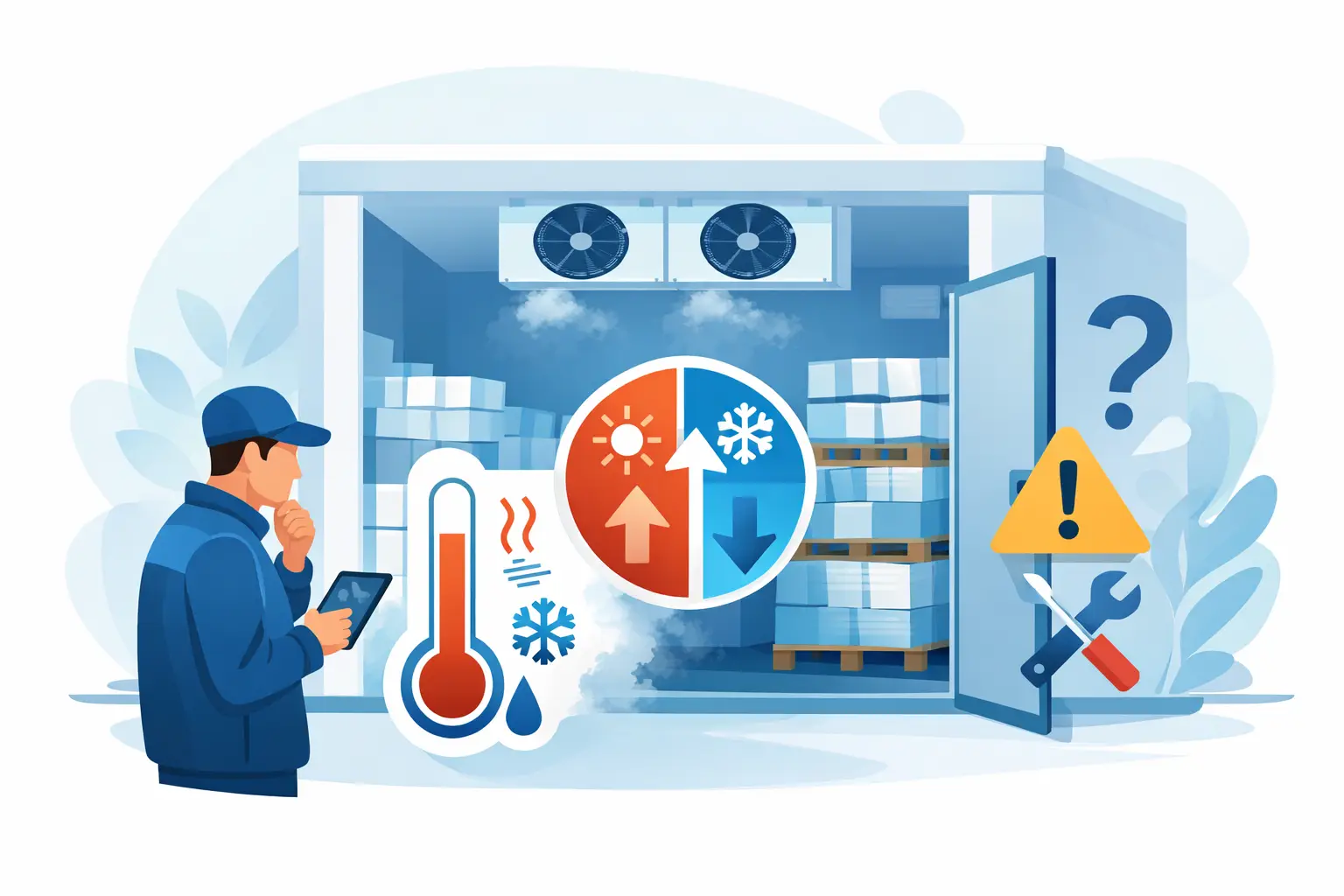
A cool room not holding temperature usually shows itself before it fails completely. Staff notice stock feeling warmer than it should, the unit seems to run longer, ice starts forming where it should not, or the room struggles after every door opening. That is the point to act. Waiting for a full breakdown usually means spoiled product, disrupted service, and a larger repair bill.
If your cool room is drifting above setpoint, the cause is not always the refrigeration unit itself. In plenty of cases, the problem comes back to airflow, door sealing, control faults, or heat getting into the room faster than the system can remove it. The right repair starts with finding the real fault, not changing parts and hoping for the best.
Why a cool room not holding temperature matters
For a business, this is not a minor comfort issue. It affects food safety, product quality, compliance, and daily operations. If you are running a café, kitchen, butcher, florist, bottle shop, or medical storage area, poor temperature control can quickly become a stock-loss problem.
There is also the wear and tear side of it. A system that cannot pull down properly will often run harder and longer. That pushes up power use and puts extra strain on compressors, fans, controls, and defrost components. What starts as a door seal issue can turn into a much bigger job if it is ignored for too long.
Common reasons a cool room stops holding temperature
Door seals are damaged or doors are not closing properly
This is one of the most common issues, and it gets missed all the time. If the gasket is split, loose, worn flat, or dirty, warm air keeps leaking in. The refrigeration system then has to keep chasing the load.
Sometimes the seal is fine but the door is out of alignment, the closer is faulty, or stock is stopping the door from shutting fully. Strip curtains can also be torn or missing, which makes a difference in busy rooms with frequent access.
Evaporator coils are iced up
When the evaporator ices over, airflow drops off and the room stops cooling properly. You might still hear the system running, but it is not doing its job efficiently. Ice build-up can point to a defrost issue, a fan problem, a refrigerant fault, or warm air getting in through the door.
This is where guessing costs money. Defrost timers, sensors, heaters, and drainage all need to be checked properly.
Condenser is dirty or airflow is restricted
If the condenser coil is clogged with dust, grease, or debris, the system cannot reject heat properly. Head pressure rises, efficiency drops, and room temperature starts slipping.
In commercial settings, this is common where the condensing unit sits near cooking areas, service yards, or dusty plant spaces. It is often preventable with scheduled maintenance, but once performance drops off, cleaning alone may not be the full answer if other components have already been affected.
Refrigerant charge is low
Low refrigerant can reduce cooling capacity and cause poor temperature control. It may also lead to ice in the wrong places or abnormal pressures through the system. The key point here is that refrigerant does not just disappear. If charge is low, there is usually a leak that needs to be found and repaired.
Simply topping it up without dealing with the leak is a short-term patch. You might get a bit of performance back, but the fault is still there.
Fans are not operating as they should
Cool rooms rely on steady airflow across coils and through the space. If evaporator fans are slow, intermittent, noisy, or not running at all, the room can develop warm spots and struggle to maintain set temperature.
Condenser fan faults can also affect system performance. In both cases, the room may seem partly operational while still failing to hold safe and stable conditions.
Temperature controls or sensors are inaccurate
If the thermostat, controller, or probe is reading incorrectly, the system may cycle at the wrong times or fail to pull down far enough. You can end up with a room that looks normal on the display but is not actually holding the right temperature.
That is why proper testing matters. A display reading on its own does not confirm the room is operating correctly.
The room is overloaded or heat load has changed
Sometimes the refrigeration system is technically working, but the load on the room has changed. More stock, hotter stock being loaded in, longer door-open times, or a failed door policy during service periods can all push a system beyond what it can comfortably handle.
This is common in growing businesses. A cool room that was adequate two years ago may no longer suit current usage.
What to check first before calling for repairs
There are a few simple things worth checking straight away. Confirm the door is closing properly and the seals are intact. Look for obvious ice build-up on the evaporator. Check whether fans are running and whether the condenser area is blocked or dirty. Make sure stock is not packed hard against the evaporator or restricting airflow through the room.
Also check the controller setting and compare it with an independent thermometer if you have one. If the room has only just started drifting, these quick checks can help narrow down what is happening.
What you should not do is keep resetting the controller or switching the unit off and on repeatedly. That can muddy the fault and make diagnosis harder when a technician arrives.
When a cool room not holding temperature needs urgent attention
If the room is storing food, perishables, or temperature-sensitive stock, urgency comes down to risk, not just inconvenience. If internal temperature is rising, product integrity is in question, or the unit is running continuously without recovering, it needs attention quickly.
The same goes for repeated icing, water leakage, tripped breakers, unusual noises, or a room that only cools at night when ambient temperatures drop. Those signs usually point to an underlying fault rather than a one-off fluctuation.
For Adelaide businesses, summer heat can make a marginal system fall over fast. A unit that just gets by in mild weather can lose control once ambient conditions rise, especially if maintenance has been deferred.
Why proper diagnosis matters
Cool room faults often overlap. A failed door seal can cause icing. Icing can affect airflow. Reduced airflow can look like a refrigerant issue. A control fault can mimic poor capacity. If you only treat the visible symptom, the call-back is usually not far away.
That is why a proper service should look at the whole system – cabinet condition, controls, airflow, coil condition, fan operation, pressures, temperatures, defrost operation, and how the room is being used day to day. No shortcuts. No surprises.
A good repair is not just about getting the room cold again. It is about getting it stable and reliable so you are not back in the same position next week.
Can maintenance prevent temperature problems?
In many cases, yes. Routine servicing will not stop every breakdown, but it does catch a lot of the issues that lead to temperature drift. Dirty coils, worn seals, fan motor wear, control problems, blocked drains, and defrost faults are all easier and cheaper to deal with early.
For commercial operators, maintenance is really about reducing disruption. You do not want to find out your cool room has a problem when it is full of stock before a busy weekend. Planned servicing gives you a better shot at avoiding that kind of timing.
What to expect from a proper repair
A proper repair starts with fault finding, not assumptions. The technician should inspect the room, test system performance, identify the root cause, explain the issue clearly, and let you know what needs to be done. If parts are required, the advice should be straightforward and practical.
That is the standard at LJ Refrigeration & Air-Conditioning. Qualified technicians only, clear pricing, and repairs aimed at fixing the cause rather than buying time with a temporary patch.
If your cool room is not holding temperature, the main thing is not to leave it and hope it settles down. Small faults rarely stay small in refrigeration. Get it checked early, protect your stock, and give the system the chance to be repaired properly before it turns into a full stop on your business day.
