
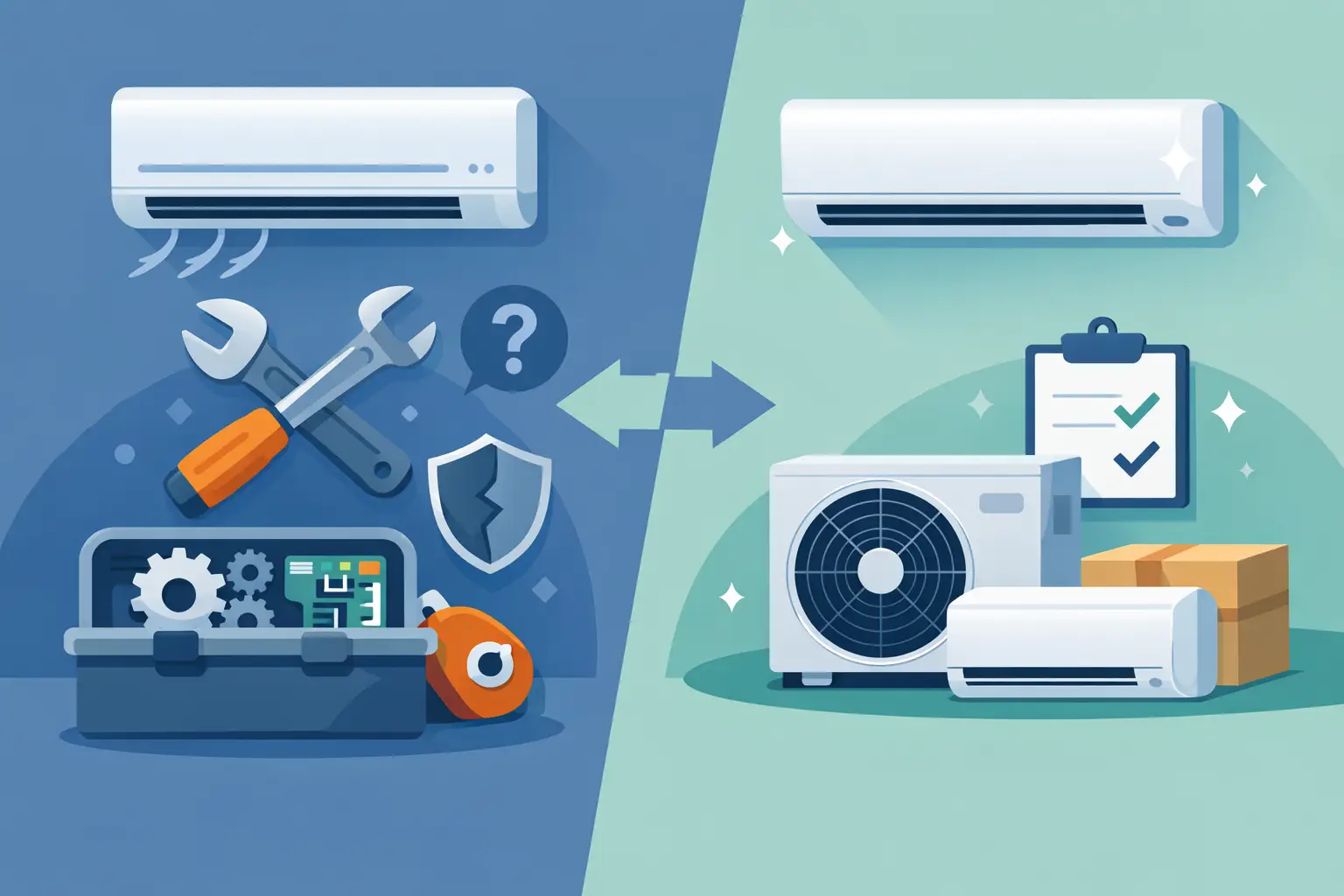
When your system starts blowing warm air in the middle of a hot week, the question comes fast: should you repair or replace aircon? For most homes and businesses, the right answer is not based on one symptom. It comes down to age, fault history, running costs, parts availability and whether the fix will actually last.
A lot of people get stuck between two bad options – spending money on a repair that buys only a few more months, or replacing a unit that still had useful life left in it. The smart decision sits in the middle. You want the option that gives you dependable cooling, fair value and the least disruption going forward.
Repair or replace aircon: start with the age
Age matters because air conditioning systems wear out in stages, not all at once. A split system that is seven years old and has its first major issue is a very different case from a ducted unit that is fifteen years old and already had several callouts.
As a general rule, a newer system is usually worth repairing if the fault is isolated and the rest of the unit is in sound condition. Once a system moves into the older end of its service life, the same repair starts to look less attractive. Even if you fix the current fault, another component may fail soon after.
That does not mean every older unit has to be replaced. Some systems have been installed well, serviced properly and still run reliably. Others have had a hard life from poor airflow, neglected filters, heavy commercial use or cheap earlier repairs. Condition matters as much as age.
When repair makes more sense
Repair is often the better choice when the problem is clear, parts are available and the unit still has good years left in it. That might be a failed capacitor, a fan motor issue, a sensor fault, a blocked drain or an electrical fault that can be diagnosed properly and fixed without patchwork.
The key point is whether the repair addresses the root cause. A proper repair should restore performance, not just get the unit limping through the next fortnight. If the coil is clean, refrigerant pressures are where they should be, the compressor is healthy and there is no pattern of repeat faults, repair is usually money well spent.
This is especially true for commercial sites where replacing a whole system can mean more downtime, coordination and cost than a targeted repair. If the system is still fit for purpose, a sound repair can keep the business running without unnecessary capital spend.
Signs a repair is likely worthwhile
If your aircon has been reliable up to now, the fault is recent and your power bills have not steadily crept up, that is a good sign. The same goes if the issue is tied to one component rather than the whole system underperforming.
You are also in better shape if the unit still cools evenly, starts and stops normally, and has not developed loud mechanical noise, repeated icing or obvious corrosion. Those details tell you whether the problem is localised or part of broader wear.
When replacement is the smarter call
Replacement starts to make more sense when repairs are stacking up, performance is dropping and confidence in the system is gone. A major compressor failure on an ageing unit is a common example. You can spend heavily on one large repair and still be left with old electronics, worn motors and lower efficiency.
Another trigger is recurring faults. If you have already paid for callouts more than once and the same room still does not hold temperature, there is a point where further spend stops being sensible. That is not saving money. It is just delaying a decision.
There is also the question of parts and refrigerant. Older systems can become harder and more expensive to support. If sourcing the right parts is difficult, or the unit relies on outdated refrigerant, replacement can be the cleaner and more reliable long-term option.
The hidden cost of keeping an old unit alive
The repair invoice is only one part of the picture. An older aircon can cost more every month through poorer efficiency, longer run times and weaker temperature control. In a home, that shows up in higher power bills and rooms that never feel quite comfortable. In a business, it can affect staff comfort, product conditions and day-to-day operations.
There is also the inconvenience factor. Repeated breakdowns mean more time waiting for technicians, more disruption and more uncertainty during peak weather. For some customers, that risk alone is enough to tip the decision towards replacement.
Repair or replace aircon based on the fault, not guesswork
Not all faults carry the same weight. A refrigerant leak, for example, is not just a matter of topping the system up and hoping for the best. The leak has to be found and repaired properly, then the system tested and recharged to specification. If that can be done and the rest of the unit is sound, repair may still be justified.
But if the leak is in a badly corroded coil on an older system, the economics change. The same goes for compressor faults, major PCB failures or damage across several components. The right decision depends on what failed, why it failed and what condition the rest of the system is in.
This is where clear diagnostics matter. You do not want a sales pitch dressed up as technical advice, and you do not want a quick fix that ignores the bigger problem. You want an honest assessment of what the repair will achieve, how long it is likely to hold, and whether replacement will save money over the next few years.
For homeowners: think beyond the upfront price
For a household, the temptation is often to choose the cheaper immediate option. That is understandable. But if the old system is noisy, inconsistent and expensive to run, replacing it can improve comfort as well as reliability.
A newer unit may cool the room faster, hold temperature better and use less power, especially if the existing system was undersized or installed poorly. If family comfort matters through summer and winter, the value of a dependable system goes beyond the initial quote.
At the same time, there is no point replacing a decent system just because it had one fault. If the unit suits the space, has been maintained and only needs a straightforward repair, replacing it too early is wasted money.
For businesses: downtime changes the maths
Commercial operators often need to make this decision faster because cooling and refrigeration are tied directly to trade. An office can lose comfort and productivity. A kitchen, retail space or cool room can face bigger operational issues if temperatures drift.
That means the repair-versus-replace decision is not just about equipment cost. It is about risk. If a repair can restore reliable operation with minimal downtime, it may be the right move. If the system is unstable and likely to fail again under load, replacement may be the safer business decision even if the upfront spend is higher.
In these situations, certainty matters. Straight answers, realistic timeframes and workmanship that lasts are worth more than a cheap temporary fix.
A simple way to decide
If you are weighing up whether to repair or replace aircon, ask four practical questions. How old is the system? What exactly has failed? Has it been reliable until now? And will this spend give you confidence for the next few years?
If the answers point to a sound unit with an isolated fault, repair is usually the sensible path. If they point to an ageing system with repeat issues, weak performance and rising costs, replacement is usually the better investment.
A good technician should be able to talk you through that without pressure. No drama, no vague promises, no shortcuts. Just an honest assessment based on the condition of the system and what will serve you best over time.
If you are still unsure, do not focus only on today’s invoice. Think about the next summer, the next power bill and the next breakdown you may or may not have to deal with. That usually makes the right choice clearer.

1 comment on “Repair or Replace Aircon? What to Check”